Take the Chord Challenge
A chord challenge is a simple test: how many chords can you play correctly, one after another, before time runs out or your hand slips under the pace. It is the difference between knowing a chord and owning it. This page covers what actually makes chord playing fast, how to train that speed on purpose, and lets you test your own hands against a shrinking clock below.
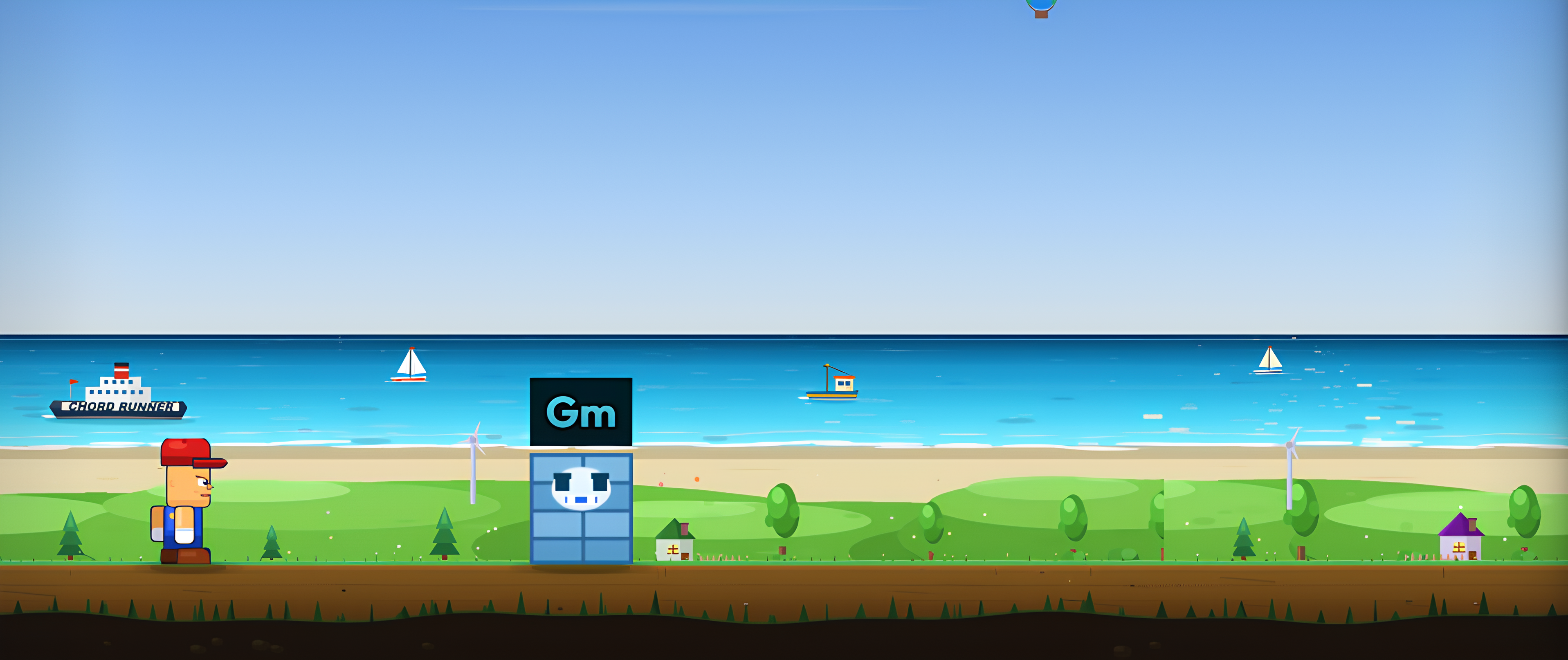
Learn by playing the actual game
A chord appears, you play it, the runner keeps going. No download, no signup. Plug in a MIDI keyboard or just use your microphone.
▶ Try ChordRunner Free Free demo - no download, no signup.What makes a chord feel fast
Speed on an instrument is not really about moving your fingers quicker. It is about how much thinking happens between hearing or reading the chord name and your hand landing on it. Slow chord playing and fast chord playing use the exact same shapes, the only thing that changes is whether you have to search for the shape or it simply arrives.
Automatic recall versus thinking it through
When you are new to a chord, naming its notes is a small research project: root, then count up the right intervals, then find each note on the instrument. That process works, but it is slow, and slow does not survive contact with a real tempo. Automatic recall skips straight from the chord's name to the shape, no research step in between, and it is built the same way any recall gets automatic: repetition with immediate, honest feedback on whether you were right.
Why accuracy always comes before speed
Practicing a wrong shape quickly does not make it right, it makes the wrong shape automatic instead, and an automatic mistake is much harder to unlearn than a slow one. Get the shape correct at a comfortable pace first. Only once it is reliably correct is it worth chasing speed, because at that point speed is testing recall, not masking a shape you never actually learned.
Try it: beat the clock
A chord name appears, you click the notes that build it on the keyboard below before the bar runs out, exactly what playing it on a real keyboard means, just with a mouse standing in for your fingers. Just two chords to start: C major is C, E, G, and C minor swaps that E for Eb, one key down. Get it right and the bar drains a little faster next time:
How to actually build speed under pressure
Start slow and add a metronome
Speed work only teaches you something if the starting point is honest. Pick a tempo slow enough that every chord lands correctly, then nudge it up in small steps, only after the current tempo feels easy rather than merely survivable. A metronome or any steady click keeps you from unconsciously slowing down on the chords you find harder, which is exactly the habit that needs training out.
Randomise the order so pattern memory cannot cheat
Practicing the same chord sequence over and over teaches you the sequence, not the chords. Your hand quietly learns "what comes next" and starts moving before you have actually recognised the current chord, which feels like speed but is not real recall. Shuffle the order every time, or better, have someone else (or a program) choose it for you, so each chord has to be recognised fresh.
Testing yourself honestly
A speed test only means something if you cannot see the next chord coming and cannot lower the bar quietly to pass it. Time yourself against a fixed, unpredictable sequence, on a real instrument rather than in your head, and let mistakes count instead of glossing over them. That is the only version of "fast" that transfers to actually playing music.
A clock is honest, but another person is even more honest. Racing a friend through the same chords in real time adds a kind of pressure a countdown alone cannot fake, since there is no quietly deciding the round does not count.
Practice this in the game
Reading about speed is nothing like testing it. Try the same idea with your own hands: play into a MIDI keyboard or a microphone, keep the chord pool small at first, major and minor triads only, and see how you hold up once the pace stops waiting for you. Invite a friend in and race the same chords in real time for the sharpest version of the test.
Common questions
Is chord speed training good for beginners, or only advanced players?
Both, as long as the chord pool matches the player. A beginner testing speed on major and minor triads only gets the same honest pressure as an advanced player doing it with full 7ths and extensions. The pool is what should change with skill level, not whether speed training happens at all.
Do I need a MIDI keyboard to test my chord speed?
No. A microphone works too, listening to your acoustic piano or guitar and checking the chord you actually played, so you can test yourself without any MIDI hardware.
How do I know I am actually getting faster, and not just memorising a pattern?
Randomise the order every time you test yourself. If a chord sequence is predictable, your hand can pre-plan the next move before you have consciously named the chord, which hides how fast your recall really is. Real speed only shows up against an order you cannot see coming.
How long does it take to play chords quickly without thinking?
It depends on the chord pool, but most players get a small set (major and minor triads) reliably fast within a few weeks of short daily sessions. Widening the pool to sevenths and extensions resets some of that speed temporarily, since each new chord type has to go through the same slow-to-fast process on its own. Pair this with chord training for the order to learn new chord types in.
Can I test my chord speed against another person, or is it solo only?
Both work. Testing solo against a clock is the simplest version, and racing a friend through the same chords in real time sharpens it further, since a real opponent exposes hesitation a countdown alone cannot.