Chord Training That Feels Like a Game
Chord training is the practice of playing chords until recognising the symbol and forming the shape happens in one motion, without thinking. The fastest way there is short daily reps with instant feedback on a real instrument: see the chord, play it, know immediately if it was right. This page shows you what to train and in what order.
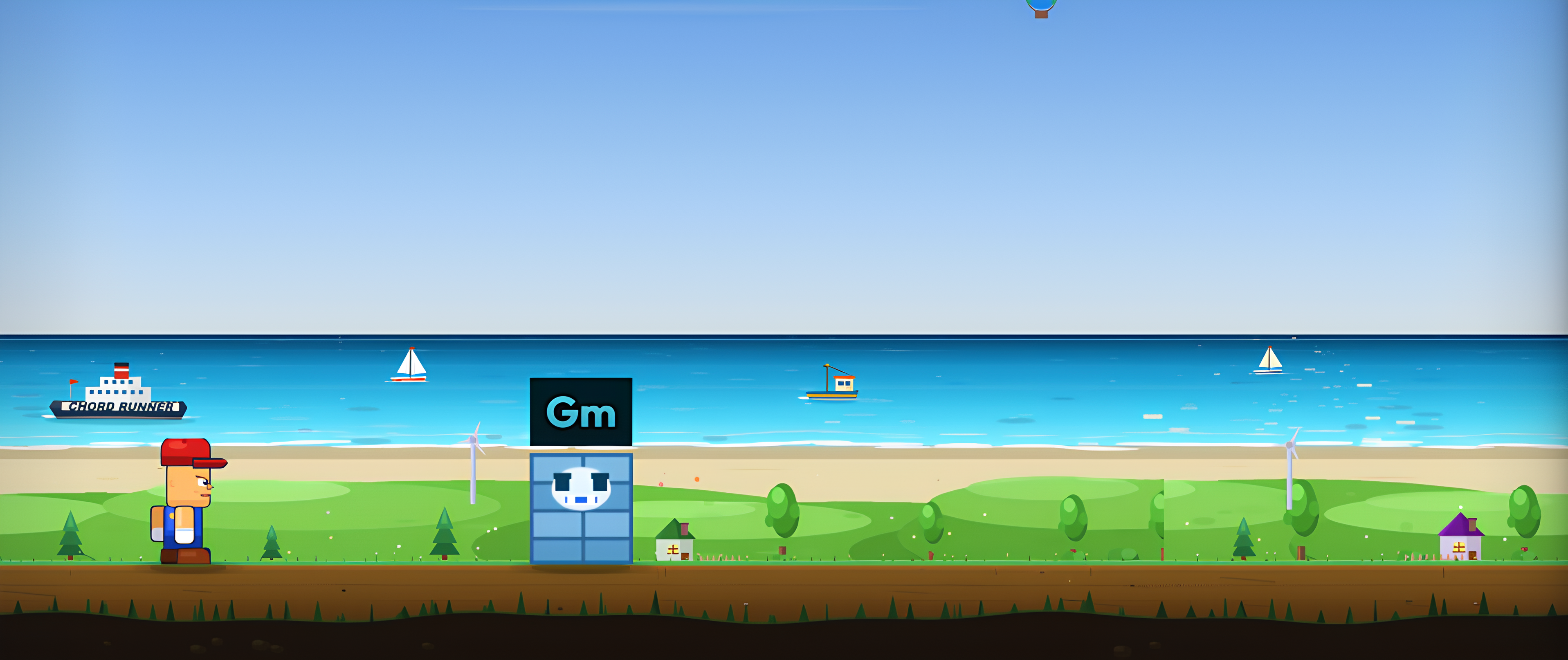
Practice chords by playing this
A chord symbol appears, you play it, the runner keeps going. No download, no signup. Plug in a MIDI keyboard or just use your microphone.
▶ Try ChordRunner Free Free demo - Level 1, all 12 major chords, right now.What actually makes a chord click
A chord is just a few notes played together, and every chord you will meet in this guide is a small variation on one you already know. Change one note in a C major chord and you get C minor. Move that same note somewhere else and you get Csus4. Add one more note and you get Cmaj7. Once your hand knows where C major sits, every other chord is one small step away, not a new shape to memorise from zero.
Knowing that in your head is not the same as feeling it in your hands. The fastest way to close that gap is to play the chord yourself and find out immediately whether you got it right. That is what ChordRunner does: a chord symbol appears, you play it on your MIDI keyboard or into your microphone, and the game tells you on the spot if the shape was correct.
See how one note changes everything
Click through the chords below and watch which key moves:
Train every chord type, step by step
Do not practice chords alphabetically or randomly. Learn one chord type at a time, in all 12 keys, before adding the next. This is the order the game's Standard Levels use, and it works away from the game too:
| Stage | Chord types | Example |
|---|---|---|
| 1 | Major triads | C, F#, Bb |
| 2 | Minor triads | Cm, F#m, Bbm |
| 3 | Major and minor mixed | the real test |
| 4 | Augmented | Caug |
| 5 | Diminished | Cdim |
| 6 | Suspended | Csus2, Csus4 |
| 7 | Seventh chords | Cmaj7, Cm7, Cm7b5 |
| 8 | Ninths | Cmaj9, Cm9 |
| 9 | Elevenths | C11, Cmaj11, Cm11 |
| 10 | Thirteenths | C13, Cmaj13, Cm13 |
| 11 | Everything mixed | 200+ chords, 17 types |
Major and minor triads
Four chords cover an enormous amount of real music. Let It Be runs on C, G, Am and F. House of the Rising Sun cycles Am, C, D, F and E. Master major and minor triads in all 12 keys and you can already accompany more songs than you will ever get around to playing. The mixed stage matters most: telling Cm from C under time pressure is where the shapes truly separate in your hands.
One practical habit from the start: say the chord name out loud, or at least in your head, every time you play it. You are building a link between three things, the printed symbol, the sound, and the hand shape, and the link only forms for the pairs you actually exercise together. Silent mechanical reps build fingers and skip the symbol.
Augmented, diminished, suspended and seventh chords
These are the colour chords. You will meet suspended chords in the crunching intro of Pinball Wizard, and the maj7 in the opening of the Beatles' Something, which walks C, Cmaj7, C7. Diminished and augmented triads appear less often but are cheap to learn: each is one changed note away from shapes you already know. Seventh chords are where accompaniment starts sounding grown up, and where jazz and soul playing begins.
Extended chords: 9ths, 11ths and 13ths
Past the 7th, chords stack more thirds: 9ths, 11ths, 13ths. They look frightening on paper and are surprisingly learnable in practice, because each extension is one more note on a shape you already own. If you play from lead sheets, gig charts or jazz standards, this is the vocabulary that stops you from silently downgrading every C13 to a plain C7.
Read any chord symbol in two steps
Chord symbols compress a lot into a few characters, but they all parse the same way. First the root: the capital letter, plus its sharp or flat. Second the quality: everything after the root. Nothing after it means major. A lone m means minor. Numbers stack thirds on top: 7, 9, 11, 13. So Bbm7 reads as root Bb, quality minor seventh, and F#11 reads as root F#, quality eleventh. Train yourself to read in that order and no symbol on a lead sheet will stop you mid-bar, even one you have never played before. The game shows the same symbols on screen, so every run is also symbol-reading practice at tempo.
Play with a MIDI keyboard or just a microphone
Zero-setup MIDI in the browser
Any USB or Bluetooth MIDI keyboard works in the browser through Web MIDI: plug in, allow access once, play. ChordRunner detects the keyboard automatically when a run starts. Nothing to install, which also means you can practice on any computer, including a school or work machine.
Microphone chord detection for piano and guitar
No MIDI keyboard? The game can listen instead. Microphone mode analyses the sound of your acoustic piano or guitar in the browser and recognises the chord you played in real time. Detection favours clean, together strikes, which quietly trains a habit worth having anyway.
Two tips for clean microphone detection: keep the room reasonably quiet, and let each chord ring for a moment instead of cutting it off. Rolled or staggered chords read as a smear of single notes, to the game and, worth noticing, to listeners too.
Practice this in the game
A useful session takes about ten minutes. Start Standard Levels at the stage matching your current edge: Level 1 if major triads still need thought, Level 3 if telling major from minor is the fight, Level 7 when sevenths are the frontier. Play until the run ends, note which chords killed you, and run it again. The game speeds up as the levels rise, so recall has to become automatic, not just correct. Level 1 with all 12 major triads is free in the demo, in the browser, right now.
A week that works looks like this: two or three runs a day at your edge level, one warm-up run a level below, and nothing more. Ten focused minutes daily beats an hour on Sunday, because chord recall is a memory skill and memory consolidates between sessions, not during them.
When you plateau between levels, narrow the problem instead of grinding the whole stage. If Level 3 keeps ending on the same few chords, the full version's Custom mode lets you build a pool of exactly those trouble chords, say Bm, Fm and Abm, and drill only them until they stop being special. Then go back to the mixed level and collect the win.
Common questions
Can I do chord training without a MIDI keyboard?
Yes. ChordRunner's microphone mode listens to your real piano or guitar and recognises chords from the audio, in the browser. A MIDI keyboard gives the most precise feedback, but the training loop of see it, play it, get judged works the same either way.
What order should I learn chord types in?
One type at a time, all 12 keys, before adding the next: major triads, minor triads, then the two mixed, then suspended, diminished and augmented, then sevenths, then extensions. Mixing too early is the most common way to stall, because similar shapes blur together.
How long until all 12 major chords are automatic?
With short daily sessions and instant feedback, most players get all 12 major triads reliable within a couple of weeks, and fast within a month or two. The honest test is speed under pressure: recall that works at a game's pace works in real songs.
Does chord training help with playing by ear?
Indirectly, a lot. Once shapes are automatic, your attention is free to listen. Pair chord training with dedicated ear training and chord recognition practice, and the two skills reinforce each other: your ear names the chord, your hand already knows it.