Slash Chords Explained
A slash chord is a chord played over a specific bass note, written as chord slash bass, so C/E means a C major chord with E in the bass. The chord itself does not change, only its lowest note does. That small move is one of the most useful tools in harmony: it smooths out bass lines and lets a plain triad imply something richer underneath.
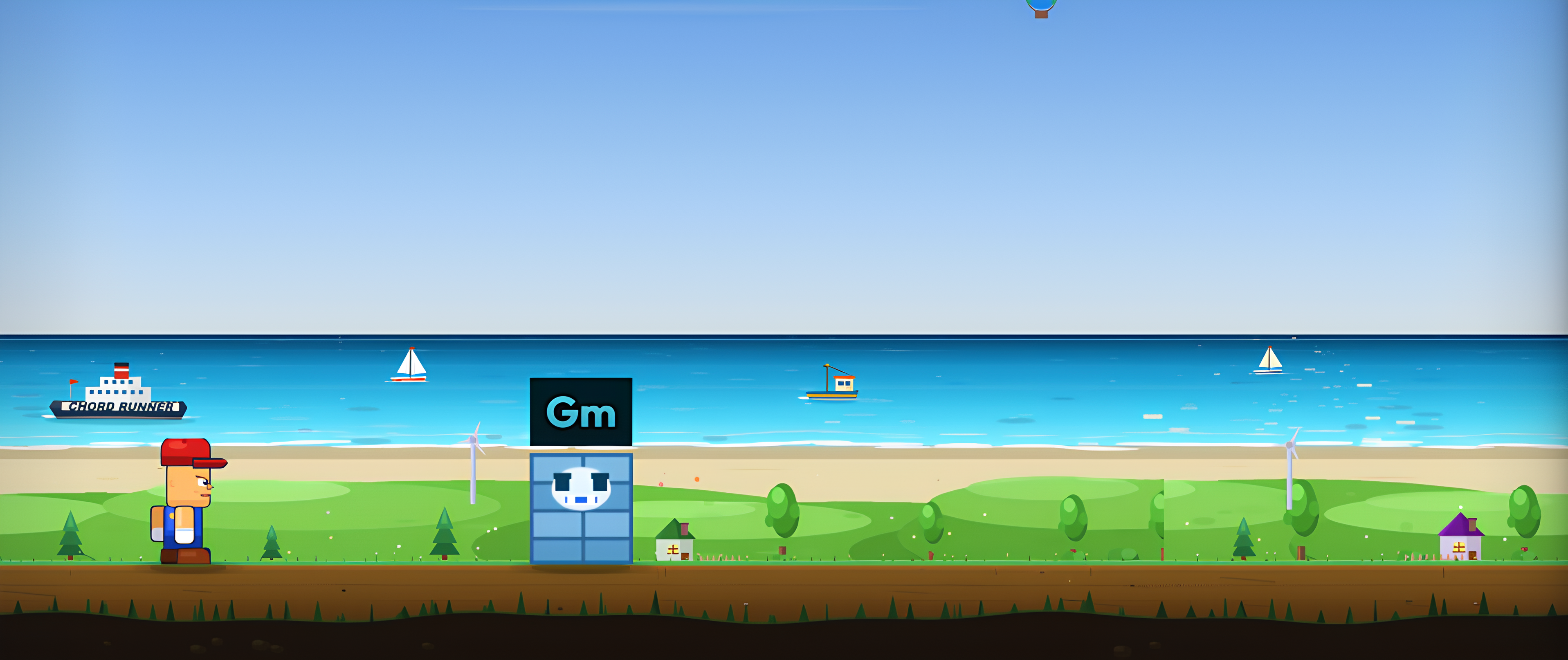
Drill slash chords by playing them
See a chord over a bass note, play it with the right note lowest, know instantly if you nailed it. No download, no signup. MIDI keyboard or microphone.
▶ Try ChordRunner Free Free in the browser - the game checks your bass note.Reading chord over bass
The notation is simple once you know the trick: whatever is left of the slash is the chord you play, whatever is right of the slash is the note that goes in the bass. C/E is a C major chord with an E at the bottom. Dm/G is a D minor chord sitting over a G. The chord on the left never changes shape, you are only told which note to drop underneath it. That is the whole idea, and it unlocks a surprising amount of real music.
Change the bass, watch what happens
Here is a C major chord. Pick a bass note and see whether you get an inversion or a true slash chord. The orange key is the bass.
Inversions versus true slash chords
There are two kinds of slash chord, and the widget above shows the line between them. If the bass note is already part of the chord, the slash chord is simply an inversion: C/E is C major in first inversion, C/G is second inversion. If the bass note is not in the chord, like C/D or C/F, it is a true slash chord that adds a fresh note underneath the harmony, colouring it without changing the triad on top. Both are written the same way, but they do different musical jobs.
Why slash chords sound so good
Their main gift is a smooth bass line. Compare jumping C, F, C with walking C, C/E, F: the second version steps the bass down C, E, F by step, and the ear loves stepwise bass movement. Songwriters use descending slash-chord bass lines constantly, think of the stepwise walk-downs in countless ballads. A true slash chord can also imply a bigger harmony cheaply: G/C is really a Cmaj9 colour played as a simple G triad over C. Once you hear it, you notice slash chords everywhere.
Practise slash chords in the game
The catch with slash chords is that the bass note matters, so playing the right chord is not enough, you have to put the right note lowest. That is easiest on a MIDI keyboard. In ChordRunner, slash chords appear as targets and the game checks your bass note specifically, so you train to place the bass correctly rather than just grabbing the triad. Free in the browser, nothing to install.
Common questions
What does a slash chord like C/E mean?
A slash chord names a chord over a specific bass note: the part before the slash is the chord, the part after is the note in the bass. C/E means play a C major chord but put E in the bass. The chord stays C major; only the lowest note changes.
What is the difference between a slash chord and an inversion?
If the bass note belongs to the chord, the slash chord is just an inversion: C/E and C/G are C major in first and second inversion. If the bass note is not part of the chord, like C/D or C/F, it is a true slash chord that adds a new colour under the harmony.
Why do composers use slash chords?
Mostly to control the bass line. Writing C/E instead of C keeps the bass moving smoothly by step, which sounds far more musical than jumping around root notes. Slash chords also let you imply richer harmony with a simple triad over an unexpected bass.
How do I practise slash chords?
You need to control which note is lowest, so a MIDI keyboard helps most. In ChordRunner, slash chords appear as targets and the game checks your bass note, so you learn to place the right note underneath, not just play the right chord.